Even if you can’t, see
finissage of the exhibition Monna Lisa by Helga Fanderl
at 6.30 pm
Even If You Can’t, Look
Finissage of the Exhibition Monna Lisa by Helga Fanderl
Friday, 12 December 2025, 6.30 pm
curated by Filippo Perfetti
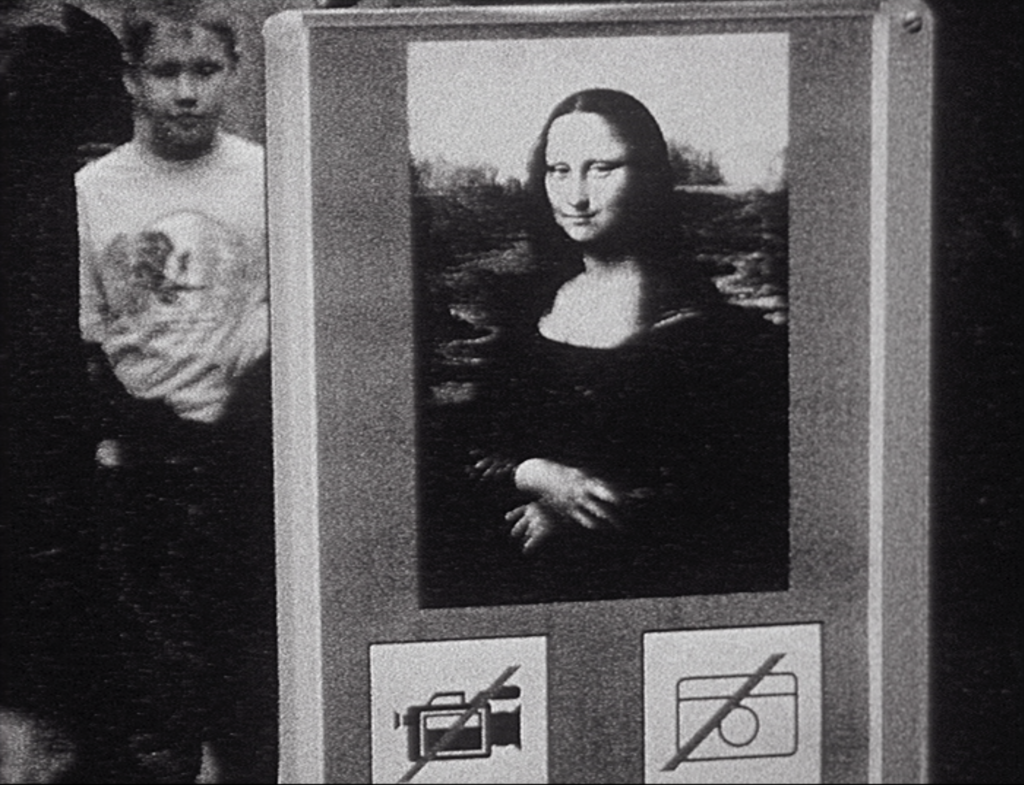
Helga Fanderl, Mona Lisa (Photo and Video Prohibited), Super 8, 2003 (courtesy of the Artist)
On the occasion of the closing of Helga Fanderl’s exhibition Monna Lisa, curated by Filippo Perfetti, altriformati presents a special film programme in dialogue with Fanderl’s work. The screening will take place on Friday 12 December 2025 at 6.30 pm at Studio Tommaseo in Via del Monte 2/1.
The German artist’s exhibition for Trieste Contemporanea is centred on vision and on the relationship between viewer and artwork: Monna Lisa invites each visitor to reflect on the fragility and richness of looking, and on the phenomenon of mass inattention (the exhibition is open for viewing until 12 December, from 5 PM to 8 PM). Read more about the exhibition
The films in the programme explore these same polarities.
Flithsight by Anna Malina, 40”, sound, colour, digital, 2024 (courtesy of Anna Malina).
With its rapid one-step pacing and its duration of less than a minute, the film evokes the fleeting nature of every act of looking, and how any face can disappear at first glance, before it has truly been seen.
Vzglyanite na litso (Look at the Face) by Pavel Kogan, 10’, sound, b&w, digital, 1966.
This documentary was filmed in front of the Madonna Litta, attributed to Leonardo da Vinci, displayed at the Hermitage in Saint Petersburg. Kogan’s film captures the wonder and amazement of those approaching the painting, as well as those photographing the artwork with the film cameras of the period in which the film was made. Look at the Face appears like a twin to Fanderl’s films—shifted eastward in latitude and shaped by a different historical sensibility.
Side Seat Paintings Slides Sound Film by Michael Snow, 20’, sound, colour, 16mm, 1970 (courtesy of Cinédoc Paris Films Coop).
Presented in 16mm, the film challenges both the act of seeing and the representation of the artwork. Snow seems to anticipate Fanderl’s idea that filming a work of art is senseless; through a point of view that makes its visual perception impossible, he offers an ekphrastic anamorphosis of his paintings, recounting the titles and characteristics of works that the viewer of the film is prevented from seeing. Yet by sacrificing the subject of observation, Snow redirects attention to his primary concern: the act of seeing itself. Even if you can’t, look.
