Trieste Contemporanea meets Villa Massimo
at 6 pm
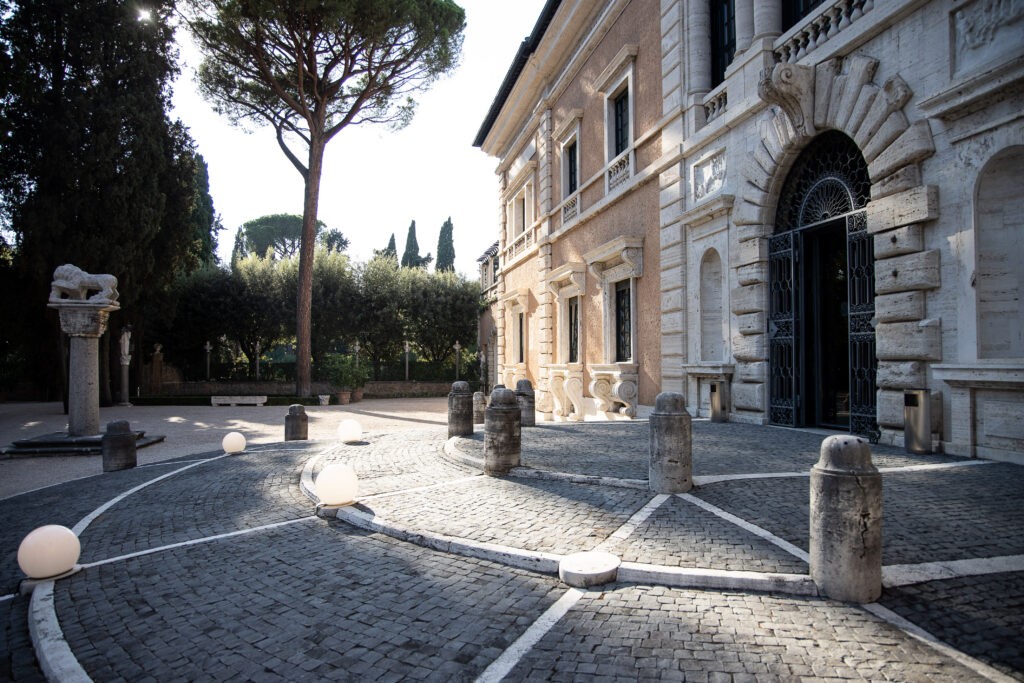
Villa Massimo (photo by Alberto Novelli)
On Thursday 12 November at 6 pm, Trieste Contemporanea presents Trieste Contemporanea meets Villa Massimo at Studio Tommaseo, a conversation with three current residents of the German Academy Rome Villa Massimo, one of Germany’s most prestigious cultural institutions based in Italy.
Julia Trolp will introduce the contributions of Ariel Magnus, a writer and translator and winner of the 2026/27 Villa Massimo Rome Prize; Anas Kahal, a visual artist and Casa Baldi fellow; and Mariana Dimópulos, a writer and translator. The German Academy Rome Villa Massimo is co-producing the event in Trieste. Bringing together different areas of culture, the event will give audiences in Trieste an opportunity to learn about the three participants’ current research and creative work.
In turn, during their visit to Trieste for Trieste Contemporanea meets Villa Massimo the Villa Massimo guests will have the opportunity to discover some of the city’s landmarks. The programme includes visits to the Museo Revoltella, introduced by museum conservator Susanna Gregorat, and the Porto Vecchio with architect Giulio Polita; a closer look at places central to Trieste’s cultural and architectural life; and an exploration of the natural and historical heritage of the Trieste Karst and the Grotta Gigante.
The Villa Massimo Rome Prizes and the Casa Baldi fellowship
For more than a century, the German Academy Rome Villa Massimo has hosted artists, giving them the opportunity to live and work in Rome for ten months at Villa Massimo or three months at Casa Baldi. In the Villa’s extensive park, with its centuries-old trees, prizewinners have ten spacious studios and adjoining apartments at their disposal, providing a setting for a period of intensive research and artistic production. The Academy also oversees Casa Baldi, in Olevano Romano, a picturesque medieval town in the hills of Lazio. Here, two artists awarded the relevant fellowships are hosted for three-month periods in a setting designed to encourage research and engagement with the local area. (https://www.villamassimo.de/it)
Artists’ study journeys to Italy have a long history, as illustrated by Johann Wolfgang von Goethe’s celebrated Italian Journey. They belong to the wider tradition of the Grand Tour — the journey through Europe, with Italy as its destination, undertaken as part of the education of young eighteenth-century aristocrats.
From the late eighteenth century onwards, many academies offered a scholarship for study in Italy as their most prestigious award, following the model of the French Prix de Rome. It enabled young artists to become familiar with the masterpieces of antiquity and with the tradition of decorating interiors for symbolic and representational purposes, particularly the frescoes of the Sistine Chapel and the Raphael Rooms in the Vatican. Fellows from academies across Europe and the Americas came to Rome.
Mariana Dimópulos
Born in Buenos Aires in 1973, she lives in Berlin and works in literature and translation, focusing on dialogue between languages and cultures. Her research encompasses writing and linguistic and cultural mediation.
Anas Kahal
Born in Damascus in 1985, he lives and works in Freiburg. He studied fine art in Damascus and at the Staatliche Akademie der Bildenden Künste Karlsruhe.
His work explores flight, exile, war and the media’s representation of conflicts. In 2025 he received the Kalinowski-Preis, and in 2026 he is a Casa Baldi fellow.
Ariel Magnus
Born in Buenos Aires in 1975, he lives in Berlin. He studied Romance philology and philosophy at the universities of Heidelberg and Berlin. Since 2005 he has worked as a writer and literary translator. He has published more than twenty novels in Spanish, translated into more than ten languages, and has received numerous international awards. He is a winner of the 2026/27 Villa Massimo Rome Prize.