Fabio Mauri
A occhi non socchiusi
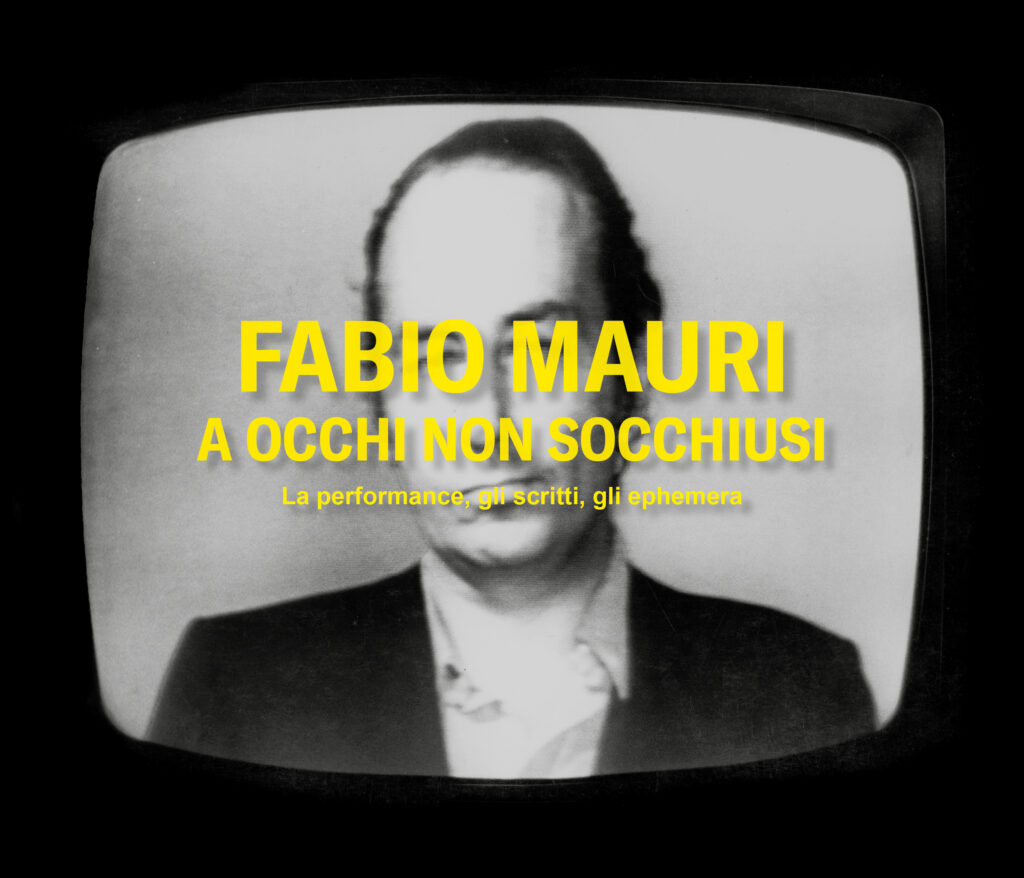
Fabio Mauri, Il televisore che piange, 1972, photograph of the video performance (courtesy of Fabio Mauri Estate, Rome)
In the year marking the centenary of the birth of Fabio Mauri (Rome, 1926–2009), Ephemera Festival, in co-production with Trieste Contemporanea / Studio Tommaseo, presents an exhibition dedicated to Fabio Mauri’s performances, curated by Sara Codutti in collaboration with the Fabio Mauri Studio in Rome.
Through photographs by the great photographers who followed the artist in his research—Elisabetta Catalano, Claudio Abate, Massimo Piersanti, Antonio Masotti, and Maria Mulas—together with material traces, documents, notes, and ephemeral materials from the artist’s archive, the exhibition reflects on his performative practice and on the relationship between action, memory, and documentation. The exhibition opens on Friday, October 2 at 6:00 p.m. at Studio Tommaseo, Via del Monte 2/1, and will remain open until December 19, 2026.
Fabio Mauri was an artist, writer, publisher, and intellectual. His work is distinguished by his prescient insights into the role of the screen in contemporary society, as well as by his exploration of memory and ideology under the authoritarian regimes of the 20th century, often investigated through his distinctive and pioneering use of performance.
The screen itself takes center stage in Il televisore che piange (The Crying Television), a television happening that opens the exhibition. Created in 1972, Mauri interrupted RAI’s regular programming, leaving viewers facing a blank white television set that broadcast the lament of a weeping voice: “we have disrupted the habitual, ordinary action of television, that of transmitting images, by transmitting nothing other than the television itself.”
In the gallery space, the exhibition unfolds as an almost cinematic sequence of black-and-white images which, arranged chronologically, document Mauri’s performances of the 1970s, highlighting in each case the distinctive linguistic qualities at play: from the complex action Che cosa è il fascismo. Festa in onore del generale von Hussel di passaggio per Roma (What is Fascism. A Party in Honour of General von Hussel Passing Through Rome) (1971), to the “bodies that stepped out of the frame” in Ebrea (1971) and Ideologia e natura (Ideology and Nature) (1973); from the imagined action Vomitare sulla Grecia (Vomiting on Greece) (1972), to the actions involving well-known figures, Oscuramento (Blackout) (1975), Intellettuale (Intellectual) (1975), and Dramophone (1976); through to the use of projections onto bodies in Senza ideologia (Without Ideology) (1975 and 1978), and the performance Europa Bombardata (Bombed Europe) (1978), cancelled “for security reasons.” The exhibition concludes with Ricostruzione della memoria a percezione spenta (Reconstruction of Memory with Perception Switched Off) (1988), a lecture-performance in which the artist experiments with an unprecedented interweaving of words and action.
Photographs of the works are accompanied by working documents, letters, sketches, and invitations, revealing a practice in which every element is carefully positioned within a highly symbolic linguistic system, constructed with meticulous precision down to the smallest detail.